


Table of Contents
I. Intro: The Billion-Kronor Question on Your Energy Bill
Ever wonder what arcane forces dictate the erratic dance of your electricity bill? Prepare yourself; the music’s about to get louder, the steps more complex. Swedish state-owned Vattenfall has just tabled a request that resonates with the weight of “hundreds of billions” of kronor: a massive investment in new nuclear power at its Ringhals plant. This isn’t merely a dry accounting exercise for suited executives. This is a seismic shift in Sweden’s energy landscape, a potential reshaping of our collective future, and yes, quite possibly a noticeable tremor in your monthly expenses. Let’s be clear from the outset: this venture into nuclear expansion is about securing future power. This is not a retread of past grievances or a claim for recompense as was the case with Germany’s nuclear phase-out and Vattenfall’s subsequent legal battles.
II. Ringhals Reloaded: What Vattenfall Wants Now
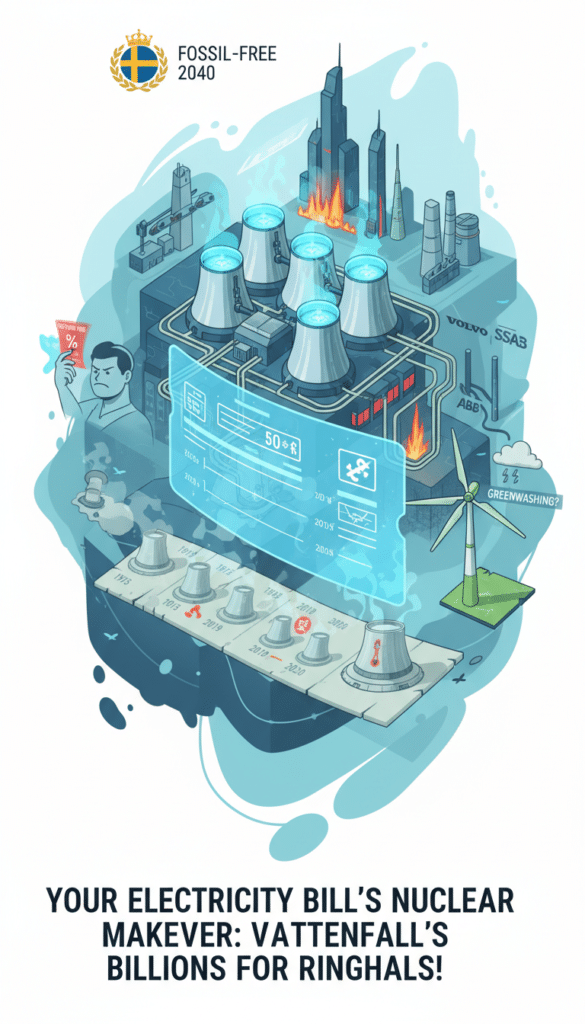
The ask is audacious: Vattenfall seeks state backing, a shared burden of risk, to erect Small Modular Reactors (SMRs) on the Ringhals site. Imagine miniature nuclear powerhouses, compact yet possessing considerable potency. The aspiration? To inject approximately 1,500 MW of dependable power into the grid. Vattenfall’s gaze is fixed on industry titans such as Rolls-Royce and GE Hitachi, purveyors of this nuclear innovation. Intriguingly, this isn’t a solitary gambit. Major players in Swedish industry – Volvo, SSAB, ABB, among others – have coalesced under the banner of “Industrikraft,” pledging 400 million SEK for a 20% stake. Their involvement underscores a deep-seated need for reliable power to fuel their own green transitions. The application landed on desks December 23, 2025, and the pivotal decision of supplier selection looms in 2026.
III. A Blast from the Past: Ringhals’ Rollercoaster History
The Ringhals narrative is one of fluctuating fortunes, reflecting Sweden’s own complex relationship with nuclear energy. Conceived in the 1960s, Ringhals, Sweden’s second-largest power station, saw its reactors spring to life between ’75 and ’83. Sweden’s relationship with nuclear has been anything but stable, initially embraced, then slated for phased obsolescence, only to swing back into favor. The narrative took a somber turn with the premature decommissioning of Ringhals 1 & 2 (2019, 2020), victims of profitability concerns exacerbated by a nuclear tax that rendered them economically unviable. Uniper, a minority stakeholder, undoubtedly felt the sting. Vattenfall’s trajectory has not been without its controversies. Allegations of taxpayer funds mishandling in the 2000s, the divestment of environmentally dubious lignite plants in Germany, and that very lawsuit against Germany over its nuclear policy have all contributed to a complex legacy.
IV. The Nuclear Renaissance: Why Sweden’s Going All In (Again)
A dramatic shift in policy has propelled Sweden into a nuclear “renaissance.” The government envisions a future studded with ten new reactors by 2035, aiming for 100% fossil-free electricity by 2040. That contentious nuclear tax? Gone. Vattenfall, aligned with this vision, is fervently pursuing “fossil freedom” by 2040. They acknowledge the limitations of relying solely on renewables, projecting a doubling of Sweden’s electricity demand by 2045. SMRs are viewed as the express lane to secure dependable, large-scale, low-carbon power, especially critical for alleviating the energy deficit plaguing southern Sweden. The participation of Industrikraft, the industrial consortium, amplifies the message: big business recognizes nuclear power as essential for achieving its sustainability goals and maintaining a competitive edge.
V. Storm Warning: The Controversies & Your Cash
Let’s confront the elephant in the room: the tangible impact on your electricity bill. How precisely will this “billion-demand” ripple through the intricate web of energy costs and land on your doorstep? The timing is particularly sensitive. Just last month (November 2025!), Vattenfall implemented a 14% hike in network fees, burdening heated homes with an additional ~130 SEK monthly. This increase has stoked public ire, particularly considering a 60% surge in these fees over the past decade. Furthermore, a Dutch court recently delivered a verdict against Vattenfall, asserting that they illegally manipulated variable contract rates. This ruling could potentially unlock billions in compensation claims across the energy sector, raising the specter of precedent-setting implications. And what of the persistent accusations of “greenwashing,” leveled by critics like Greta Thunberg, regarding Vattenfall’s investments in biomass? Let’s not forget the pause on an offshore wind project, attributed to insufficient government funding for essential cables. These swirling controversies underscore the delicate equilibrium between large-scale investments, ambitious climate targets, and the financial realities faced by consumers.
VI. Powering Towards the Future: What’s Next for Ringhals & Your Power
The future, as envisioned by Vattenfall and the Swedish government, is one powered by nuclear innovation. The SMRs are slated for commercial operation in the early 2030s. Meanwhile, Ringhals 3 & 4 are not destined for obsolescence. Plans are underway to extend their operational lifespan into the 2040s, possibly even the 2060s, requiring an additional investment of SEK 40-50 billion. The EU’s involvement adds another layer of complexity. State aid requires the imprimatur of the EU Commission, a process fraught with potential hurdles. Ultimately, Sweden’s audacious bet on nuclear power, spearheaded by Vattenfall, represents a monumental undertaking with far-reaching consequences. It’s about safeguarding future energy supplies, decarbonizing industries, and managing the costs that will inevitably find their way into your mailbox. The debate is far from settled.